
In the digital economy, having a good product is no longer enough. For micro, small, and medium enterprises (MSMEs), the ability to communicate value can be as important as the value of the product itself. A quality coffee product may remain invisible without compelling storytelling. A culinary business may struggle to compete when its digital content only describes ingredients and prices. A creative product may lose its distinctive identity when its brand message changes from one platform to another.
This is where digital entrepreneurship increasingly intersects with capability development.
Rather than asking only how MSMEs can “go digital,” a more important question is emerging: how can MSMEs develop the capabilities required to operate, communicate, and compete effectively in digital markets?
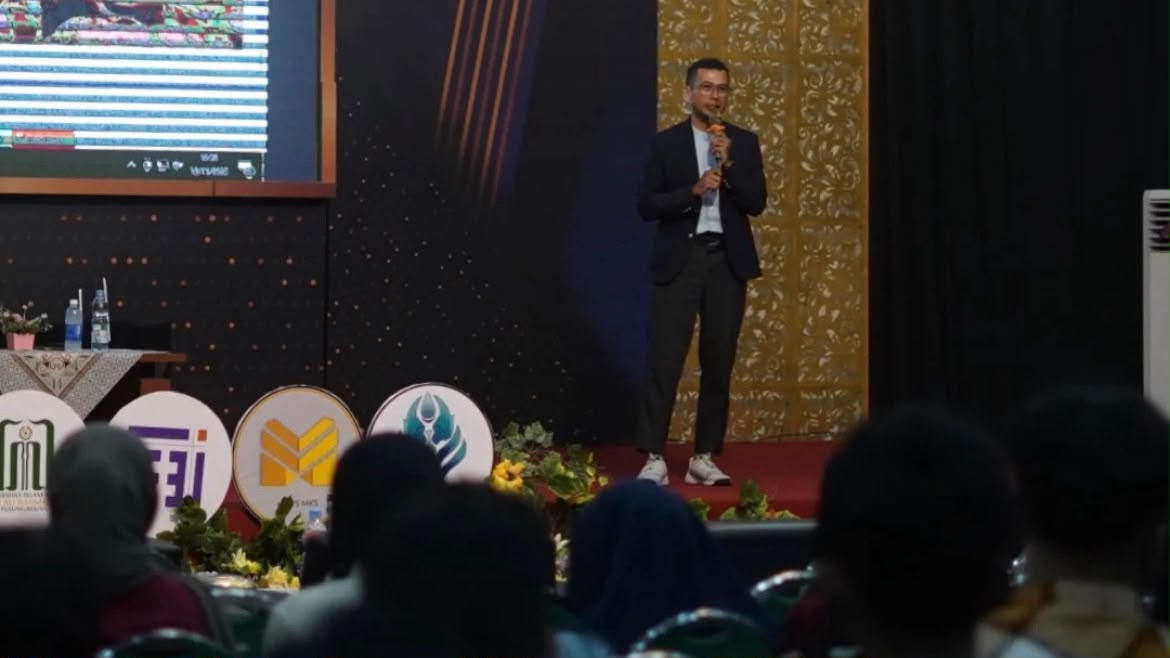
This question became the starting point of a community engagement program involving 30 MSMEs supported by Bank Negara Indonesia (BNI) and the Integrated Business Service Center (PLUT) of the Office of Cooperatives and MSMEs of Tulungagung Regency. Conducted through a participatory workshop, the program focused on copywriting, multiformat content branding, and omnichannel marketing through a co-creation approach.
The central idea was simple but strategic: digital transformation should not stop at platform adoption; it must develop the capability to create and coordinate value across platforms.
From Digital Presence to Digital Capability
Many MSMEs have already entered the digital marketplace. They use Instagram, marketplaces, messaging applications, and community networks to communicate with customers. Yet being present on several platforms does not automatically mean that a business has an integrated digital marketing strategy.
The challenge is often found in the content itself.
Digital communication requires businesses to answer several fundamental questions: What makes the product valuable? Who is the customer? What problem does the product solve? Why should customers choose this brand? And, perhaps most importantly, what should customers do after seeing the content?
These questions transform copywriting from a simple writing activity into a strategic business capability.
The workshop therefore introduced three practical frameworks—AIDA (Attention, Interest, Desire, Action), PAS (Problem, Agitate, Solution), and FAB (Features, Advantages, Benefits). Rather than treating these frameworks as abstract marketing theories, participants applied them to their own products and business contexts.
The objective was not to teach MSMEs how to produce more content.
It was to help them produce more purposeful content.
Co-Creation: Learning by Creating
A distinctive element of the program was its use of co-creation. Participants were not positioned merely as recipients of knowledge. They were actively involved in identifying communication problems, developing messages, discussing customer perspectives, and creating promotional materials.
This approach changes the character of community engagement.
Traditional training often follows a one-way model: experts provide knowledge, while participants receive it. Co-creation introduces a different logic. Knowledge is developed through interaction, experimentation, feedback, and contextual application.
For MSMEs, this distinction matters because every business has a different story, customer segment, product proposition, and competitive environment.
A coffee roastery cannot communicate in exactly the same way as a culinary business. A creative-industry entrepreneur may need to emphasize uniqueness and craftsmanship, while a service business may need to emphasize trust and customer experience.
Co-creation allows these differences to become part of the learning process.
The result is not simply knowledge acquisition, but the development of context-specific entrepreneurial capability.
Why Omnichannel Marketing Matters
The second strategic dimension of the program was omnichannel marketing.
MSMEs increasingly operate across multiple digital touchpoints. Customers may discover a product through social media, ask questions through messaging applications, compare prices through a marketplace, and eventually purchase through another channel.
This customer journey creates an operational challenge: how can a business maintain one coherent brand identity across different channels?
Omnichannel marketing provides an answer by emphasizing integration rather than simply multiplication of channels.
The workshop encouraged participants to translate a consistent brand narrative into different content formats and platforms. A single value proposition could become a social media caption, marketplace description, short-video concept, visual promotional message, or community communication.
The emphasis was therefore not on creating identical content everywhere, but on creating consistent meaning across different formats and customer touchpoints.
This distinction is particularly important for resource-constrained MSMEs. They do not necessarily need sophisticated marketing technology to begin developing an omnichannel capability. They first need a clear brand message and a systematic way to adapt that message.
From Training to Tangible Outputs
One of the important outcomes of the program was the production of practical marketing assets.
The 30 participating MSMEs represented diverse sectors, including culinary, coffee, creative industry, service, and retail businesses. During the workshop, participants developed promotional captions, improved marketplace product descriptions, omnichannel branding plans, and multiformat content ideas that could be directly adapted to their business activities.
This output-oriented approach provides an important perspective for evaluating community engagement.
Success should not be measured solely by whether participants attended a workshop or listened to a presentation. It should also be evaluated through what participants can create and apply after the learning process.
In this sense, a marketing caption is not merely a piece of text. It is evidence of an emerging capability to articulate value.
A product description is not merely marketplace content. It represents an attempt to translate product characteristics into customer-oriented benefits.
Likewise, an omnichannel branding plan is not simply a marketing document. It represents an initial step toward more coordinated digital marketing operations.
A New Perspective on MSME Empowerment
The experience offers a broader insight for MSME development programs.
Digital empowerment should move beyond the question of whether entrepreneurs have access to digital platforms. The more strategic issue is whether they possess the capabilities to use those platforms effectively and consistently.
This shifts the focus from technology adoption to capability building.
It also creates an important connection between entrepreneurship and operations management. Digital marketing activities involve processes: identifying customer needs, developing value propositions, producing content, adapting messages to different channels, responding to customers, and continuously refining communication.
When these activities become more structured, digital marketing is no longer an isolated promotional function. It becomes part of the firm's broader operational capability.
This perspective is particularly relevant for MSMEs in emerging economies, where limited resources make strategic coordination essential.
From Local Engagement to Broader Research Agenda
The Tulungagung experience also points toward a broader research agenda.
The intersection between digital entrepreneurship, MSME innovation, co-creation, omnichannel marketing, and capability development provides opportunities for further investigation. Future studies can examine how co-created digital capabilities influence business model innovation, customer engagement, operational efficiency, and sustainable competitive advantage over time.
The community engagement setting can therefore function as more than a service activity. It can become a living context for understanding how entrepreneurial capabilities are developed, tested, and translated into practice.
This is where community engagement and academic research can meet.
Universities can contribute knowledge, methods, and facilitation. Government institutions can provide ecosystem support. Financial institutions can connect MSMEs with broader business networks. Entrepreneurs contribute contextual knowledge and real-world experimentation.
Together, these actors can create an ecosystem in which digital transformation becomes a collaborative process rather than an individual entrepreneurial burden.
Beyond Going Digital
The most important lesson from this program is perhaps the simplest: MSMEs do not merely need to go digital; they need to become capable of operating in digital environments.
That capability begins with understanding the customer, articulating value, telling a compelling brand story, and maintaining consistency across customer touchpoints.
Copywriting may appear to be a small technical skill. In practice, it can become a gateway to a much broader entrepreneurial capability: the ability to understand customers, formulate value propositions, coordinate marketing processes, and transform business knowledge into market-facing innovation.
Co-creation strengthens this process by making entrepreneurs active participants in their own capability development. Omnichannel marketing extends it by connecting communication across multiple digital touchpoints.
The broader implication is clear. Digital transformation becomes meaningful when technology is accompanied by capability, and capability becomes sustainable when it is built through practice, collaboration, and continuous learning.
For MSMEs, that may be the difference between simply being visible online and becoming genuinely competitive in the digital economy.
For universities, it represents an opportunity to position community engagement not only as social contribution, but also as a platform for research-informed innovation, entrepreneurial capability development, and regional economic transformation.
And for the future of sustainable entrepreneurship, the challenge is no longer simply to create more businesses.
It is to build businesses that are increasingly capable of learning, adapting, collaborating, and creating value in a changing world.
Coffee. Research. Create. Repeat.

Scholarly Discussion & Comments
Peer Inquiries, Methodological Feedback & Academic Dialogue
Constructive scholarly reflections, methodology questions, and empirical dialogue are welcomed. Comments are moderated for academic integrity.
Submit Scholarly Review & Inquiry
Published Peer Inquiries & Reviews
0