
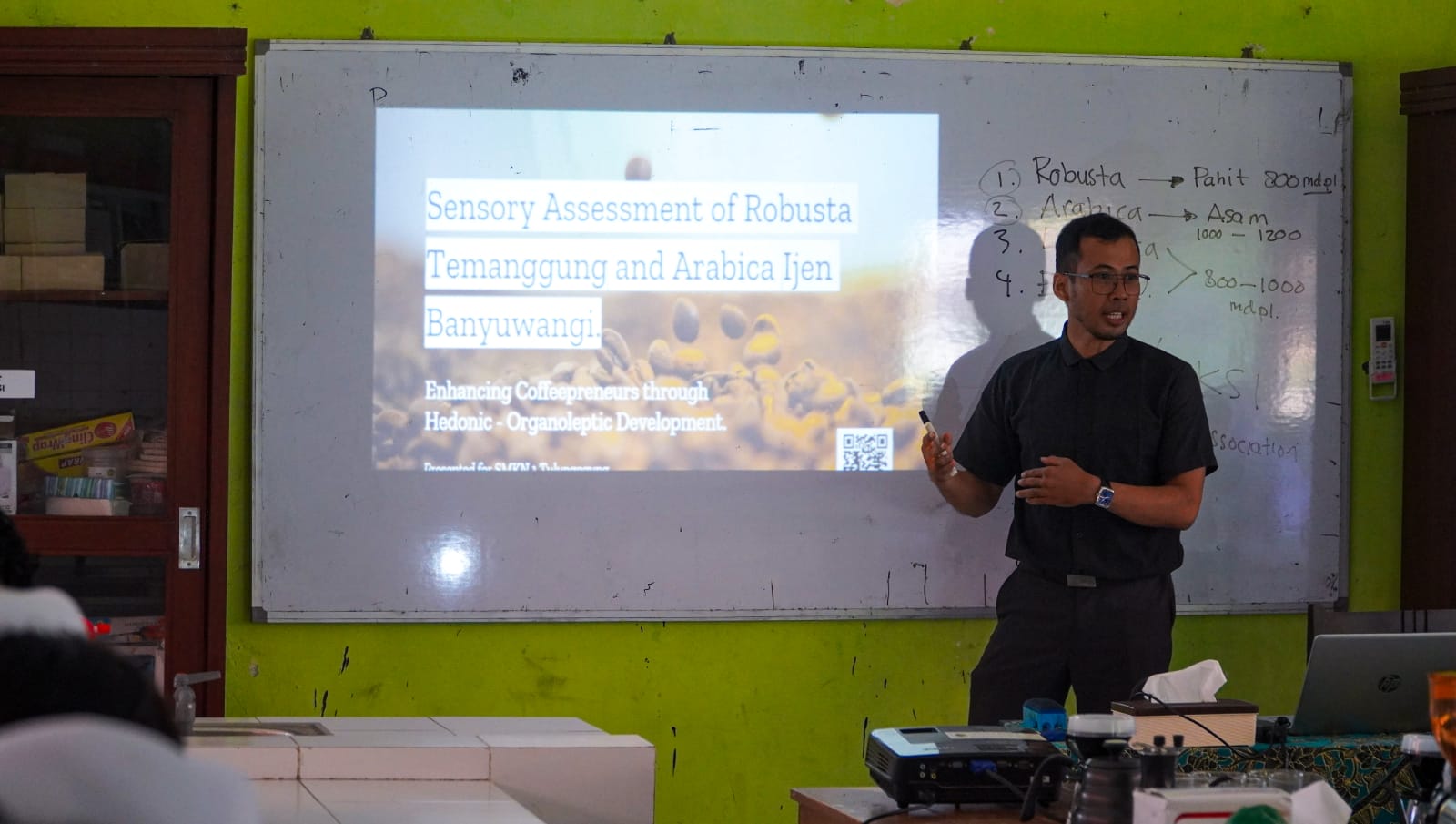
Tulungagung, Indonesia — What if the future competitiveness of Indonesia’s coffee industry does not begin with another coffee shop, another roasting machine, or another coffee brand—but with the ability of young people to understand what is actually inside the cup?
This question became the starting point of a community engagement program conducted with Grade XII students of the Agricultural Product Quality Control (PMHP) specialization at SMKN 1 Tulungagung. Through hedonic–organoleptic coffee assessment, standardized cupping practices, and basic barista training, the program sought to address a challenge that is often overlooked in discussions about coffee industry development: human capital capability.
Indonesia is globally recognized as a major coffee-producing country, yet producing coffee is fundamentally different from building a competitive coffee industry. The value of coffee increasingly depends on what happens beyond cultivation—from quality control and post-harvest handling to sensory evaluation, processing, brewing, branding, and consumer experience.
In this changing landscape, the coffee industry requires more than workers who can prepare a cup of coffee. It needs people who understand quality, recognize sensory characteristics, interpret consumer preferences, maintain operational consistency, and translate product characteristics into market value.
This is where vocational education becomes strategically important.
Beyond Learning How to Make Coffee
For many people, coffee training is synonymous with learning how to operate an espresso machine or prepare a visually appealing beverage. Yet professional coffee operations involve a much broader set of competencies.
A barista, quality controller, roaster, coffee entrepreneur, or sensory evaluator must understand why two coffees taste different, how processing influences sensory characteristics, how brewing parameters affect extraction, and how quality can be assessed systematically rather than merely based on personal preference.
The distinction between liking a coffee and evaluating a coffee is therefore fundamental.
Hedonic assessment focuses on preference and acceptance—whether a product is liked or disliked—while organoleptic evaluation examines observable sensory characteristics through sight, aroma, taste, mouthfeel, and related attributes. When these approaches are integrated with structured cupping procedures, sensory perception can become a meaningful source of operational information.
For vocational students, this represents an important shift: taste is no longer simply a personal experience; it becomes data for quality management.
Turning Sensory Knowledge into Operational Capability
The intervention at SMKN 1 Tulungagung was designed around this principle.
The program involved 32 Grade XII PMHP students and combined three interconnected approaches: technical training, continuous education, and industry awareness. Students were introduced to Robusta and Arabica coffee, sensory attributes, coffee value chains, and the principles of standardized coffee cupping.
The learning process was deliberately practice-oriented.
Students worked with coffee samples and were introduced to equipment and procedures used in sensory assessment. They learned to observe aroma, acidity, body, sweetness, flavor clarity, and aftertaste. At the same time, they were introduced to basic barista competencies, including grinding adjustment, dosing, tamping, and brewing consistency.
The objective was not simply to transfer knowledge.
It was to create operational competence.
This distinction is particularly important in vocational education. Knowledge tells students what something is. Practice teaches them how to do it. Industry-oriented education must go one step further by helping students understand why the process matters to business performance.
In this context, coffee sensory evaluation becomes connected directly with Operations Management.
Quality consistency, process standardization, equipment utilization, human competency, process control, and customer satisfaction are all operational concerns. A student who learns to identify sensory deviations is, in effect, learning one of the fundamental principles of quality management: detecting variation before it becomes a larger operational problem.
From Cup to Competence
The results of the program demonstrate why this approach matters.
Following the intervention, students demonstrated improvements across several dimensions, including theoretical understanding, sensory evaluation, cupping protocol practice, basic barista skills, professional communication, and vocational readiness.
The strongest improvement emerged in standardized cupping practice. This finding is particularly meaningful because it illustrates the value of experiential learning: competencies that initially appear abstract become more accessible when students are given the opportunity to repeatedly observe, practice, compare, and calibrate.
Students also became more confident in communicating sensory characteristics using professional terminology.
This is an important outcome.
In the modern coffee industry, the ability to communicate quality is almost as important as the ability to perceive it. A coffee producer needs to communicate with a roaster. A quality controller needs to communicate with a production team. A barista needs to communicate with consumers. An entrepreneur needs to translate sensory characteristics into a compelling product proposition.
Thus, sensory literacy can become a form of business literacy.
Why Tulungagung Matters
The significance of this initiative extends beyond the classroom.
Tulungagung has an emerging coffee ecosystem with both Robusta and Arabica production potential. Yet regional competitiveness cannot depend solely on the availability of agricultural commodities. The region also needs human resources capable of converting agricultural resources into higher-value products and services.
This is where the relationship between vocational education, coffee SMEs, and regional economic development becomes increasingly important.
A stronger vocational ecosystem can supply skilled workers to coffee businesses. Coffee businesses can provide real-world learning environments. Universities can contribute research, training, and innovation. Local producers can provide raw materials and industry knowledge. Government and community organizations can facilitate ecosystem development.
The result is a potential academic–industry–community ecosystem in which education is not isolated from economic development.
Such an ecosystem is particularly relevant for Indonesia’s specialty coffee sector, where differentiation increasingly depends on quality, traceability, sustainability, storytelling, and consumer experience.
From Capacity Building to Sustainable Entrepreneurship
The broader lesson from this program is that capacity building should not stop at technical training.
Vocational competency can become an entry point for entrepreneurship.
A student who understands coffee quality may eventually become a quality controller. Another may become a professional barista. Another may develop a roasting business. Others may work with farmers to improve post-harvest quality or develop digital marketing strategies for local coffee products.
In other words, vocational education can become part of the entrepreneurial infrastructure of a region.
This perspective aligns with a broader research agenda around sustainable entrepreneurship and SME innovation: local resources become economically meaningful when supported by capable human capital, knowledge, technology, and entrepreneurial institutions.
Coffee therefore provides more than a product context. It provides a living laboratory for studying how operations, entrepreneurship, sustainability, and human capital interact.
The Strategic Meaning of “Operational Excellence”
Operational excellence is often associated with factories, supply chains, productivity, or process efficiency. Yet the coffee industry demonstrates that operational excellence can also begin with something as subtle as taste.
A coffee business cannot achieve consistency if its people cannot recognize quality variation.
It cannot innovate effectively if it cannot evaluate its products.
It cannot build customer trust if the sensory experience changes unpredictably from one cup to another.
And it cannot compete sustainably if the knowledge required to maintain quality is concentrated in only a few individuals.
Therefore, developing sensory competency among young vocational learners is not merely an educational intervention. It is an investment in the operational capability of the future coffee industry.
From Local Practice to Global Relevance
The experience at SMKN 1 Tulungagung offers a broader proposition for developing coffee-producing regions.
The challenge is no longer simply how to produce more coffee.
The more strategic question is:
How can local coffee ecosystems develop the human capabilities required to create greater value from what they already produce?
The answer may lie in connecting vocational education with sensory science, operational management, entrepreneurship, and industry collaboration.
From that perspective, a cup of coffee becomes more than a beverage. It becomes a point of convergence between agriculture, education, technology, operations, entrepreneurship, and regional development.
And perhaps this is where the real meaning of capacity building lies—not simply teaching students how to taste coffee, but empowering them to understand quality, manage processes, create value, and ultimately participate in shaping the future of Indonesia’s coffee industry.
From sensory evaluation to operational excellence. From vocational competence to entrepreneurial capability. From local coffee to global value.
Coffee. Research. Create. Repeat.

Scholarly Discussion & Comments
Peer Inquiries, Methodological Feedback & Academic Dialogue
Constructive scholarly reflections, methodology questions, and empirical dialogue are welcomed. Comments are moderated for academic integrity.
Submit Scholarly Review & Inquiry
Published Peer Inquiries & Reviews
0