
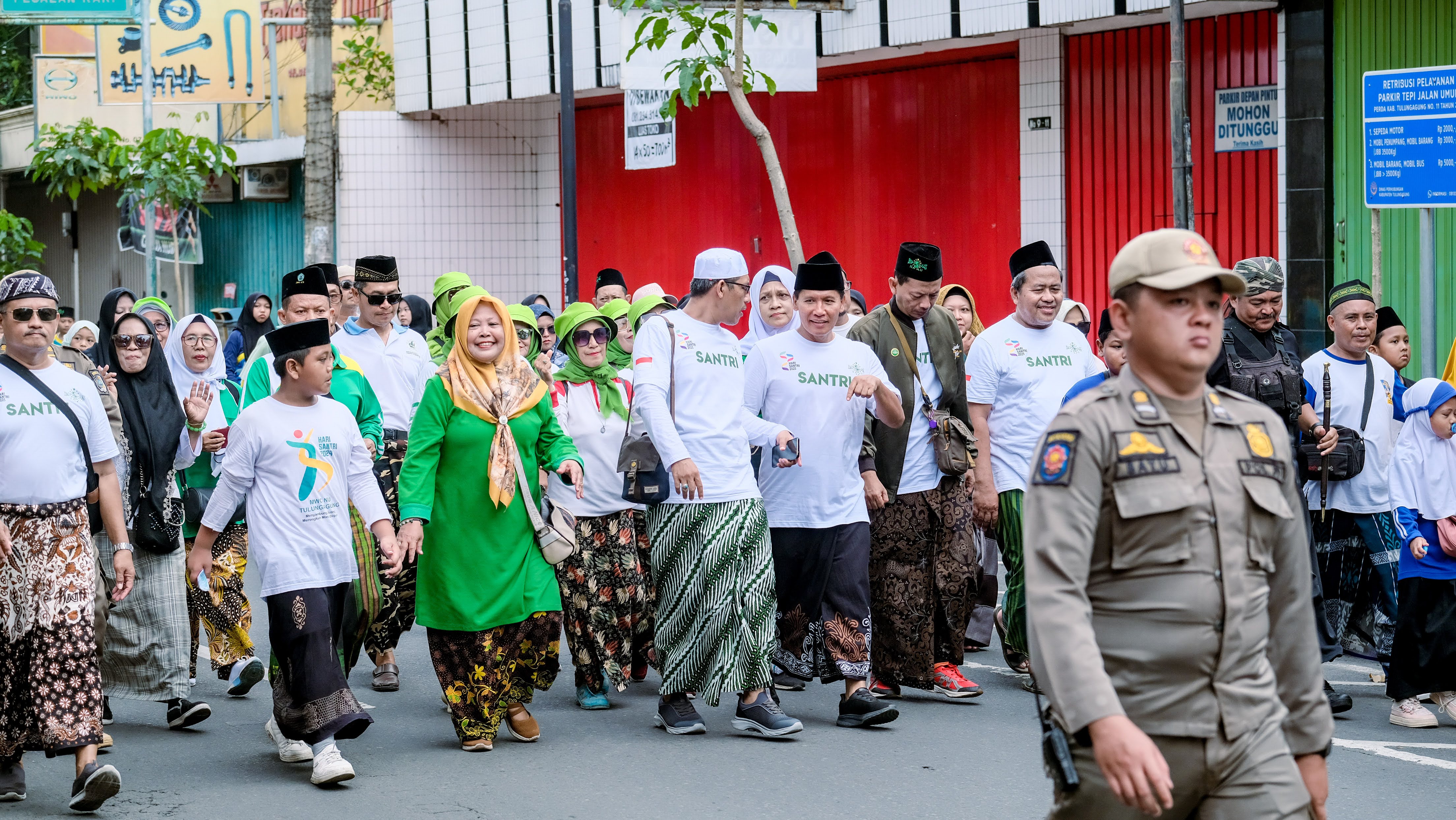
A public celebration can be more than a celebration. It can become a marketplace of ideas, a meeting point for communities, and even a platform for local economic transformation.
This perspective emerged from the National Santri Day 2025 celebration in Tulungagung, East Java, where approximately 2,000 participants gathered for a community walking event. At first glance, the event appeared to be a large-scale social and cultural gathering. Yet behind the crowd, something more strategic was taking place: universities, government institutions, businesses, community organizations, MSMEs, and media organizations were brought together within a single collaborative ecosystem.
The experience raises an important question for regional development: Can community events become instruments for strengthening local entrepreneurship ecosystems?
The answer, based on this initiative, is yes—but only when the event is deliberately designed as a platform for collaboration rather than treated merely as a ceremonial occasion.
From Event Management to Ecosystem Building
Micro, small, and medium enterprises (MSMEs) are often discussed in terms of production capacity, access to finance, or digital marketing. These dimensions are important, but they do not fully explain why many local businesses struggle to grow.
The deeper challenge is often ecosystem-related.
A good product does not automatically create a sustainable business. Entrepreneurs also need networks, market access, institutional support, knowledge, visibility, trust, and opportunities to collaborate.
This is where the concept of the entrepreneurship ecosystem becomes relevant. Rather than viewing entrepreneurs as isolated economic actors, the ecosystem perspective places them within a network of institutions and relationships that influence entrepreneurial development.
In Tulungagung, this ecosystem includes universities, government agencies, business actors, community organizations, media, and local consumers. Each possesses different resources. Universities contribute knowledge and research. Government provides policy and institutional support. Businesses contribute market experience. Communities provide social capital and participation. Media creates visibility and public awareness.
The challenge is not necessarily the absence of these actors.
The challenge is connecting them.
The Pentahelix as a Bridge
The National Santri Day initiative adopted a Pentahelix approach involving Academia, Business, Community, Government, and Media (ABCGM).
Academia was represented by Universitas Tulungagung and Universitas Nahdlatul Ulama Blitar. Their role extended beyond conventional academic functions toward entrepreneurship education, community engagement, and knowledge transfer.
The business dimension involved Kedai Kosim, Kampung Susu Dynasti, Nasi Uduk Bang Jenggot, BRP Cellular, Kopi Keliling, and other local MSMEs. Their participation transformed the event into a space for product exposure, direct customer interaction, and business networking.
The community dimension was strengthened through Nahdlatul Ulama Tulungagung and the Lembaga Kemaslahatan Keluarga Nahdlatul Ulama (LKKNU), which mobilized community participation and connected entrepreneurial activities with existing social networks.
Government institutions—including relevant regional agencies, Polres, Kodim, and Rumah Sakit UD Campurdarat—provided institutional and operational support. The event was officially inaugurated by the Vice Regent of Tulungagung, demonstrating public-sector recognition of collaborative community empowerment.
Meanwhile, Radar Tulungagung, Kacamata Tulungagung, and Indosat Ooredoo contributed through media exposure and digital communication.
The result was not simply a successful event.
It was a temporary entrepreneurship ecosystem in motion.
When Community Participation Becomes Economic Capital
One of the most interesting lessons from the initiative was the role of community participation.
Approximately 2,000 people attended the event, supported by nearly 200 door prizes contributed by donors and partners. The scale of participation demonstrated the mobilization capacity of community networks.
But participation itself is not the final objective.
The more important question is how participation can be converted into social and economic value.
When consumers meet local entrepreneurs, when students interact with business owners, when government officials engage with MSMEs, and when media organizations amplify local products, social interaction becomes an economic resource.
This is particularly relevant for communities with strong social networks and cultural identities. The National Santri Day momentum created a shared social context that made entrepreneurship engagement more accessible and meaningful.
In this sense, culture can become an enabler of entrepreneurship.
The lesson is important for regional development: entrepreneurial ecosystems do not always have to begin with sophisticated infrastructure. Sometimes, they can begin with existing communities, trusted networks, and shared cultural momentum.
Moving MSMEs from Product Readiness to Market Readiness
Another important finding concerns the distinction between having a product and being ready for the market.
Many local MSMEs already possess products with commercial potential. The challenge lies in communicating value, reaching consumers, building a recognizable brand, and establishing sustainable market relationships.
Therefore, entrepreneurship empowerment should not stop at production training.
It should address the entire journey:
product → branding → digital visibility → customer engagement → networking → market access → sustainable growth.
The National Santri Day event provided an opportunity to shorten this journey by placing MSMEs directly in front of a large community audience.
The physical booth became more than a sales point. It became a space for storytelling, interaction, experimentation, and feedback.
Combined with digital media exposure, the event created both offline and online touchpoints for local entrepreneurs.
This is where community events can complement digital entrepreneurship. Digital platforms expand reach, while physical events create trust and direct interaction. The combination can produce a stronger entrepreneurial engagement model than either approach alone.
Universities as Ecosystem Orchestrators
The experience also reinforces a changing role for universities.
A university's contribution to society should not be measured only by the number of publications it produces. Its broader value lies in its capacity to connect knowledge with real-world problems.
In entrepreneurship development, universities can act as ecosystem orchestrators and knowledge bridges.
They can connect students with entrepreneurs, researchers with industry, communities with government, and local businesses with broader markets.
This role is particularly relevant for universities located outside Indonesia's major metropolitan centers. Regional universities possess a strategic advantage: proximity to local communities and a direct understanding of regional economic challenges.
Community service, therefore, should not be positioned as an activity separate from teaching and research. It can become a bridge connecting the three missions of higher education: education, research, and societal impact.
From One Event to a Sustainable Ecosystem
The most important question after an event is not how successful the event was.
It is: What remains after the event ends?
A one-day event can generate exposure, but an ecosystem requires continuity.
The next stage should therefore involve continuous MSME mentoring, digital marketing assistance, entrepreneurship incubation, business networking, collaborative research, and recurring public engagement activities.
The Pentahelix network established during the event can become the foundation for a longer-term regional entrepreneurship platform.
Imagine a system in which MSMEs receive continuous mentoring from universities, government agencies facilitate access and policy support, communities become market and social networks, media strengthens digital visibility, and businesses become partners in innovation and market development.
That is more than an event.
That is an entrepreneurship ecosystem.
A Broader Lesson for Regional Entrepreneurship
The Tulungagung experience offers a broader perspective for Indonesia's regional entrepreneurship agenda.
Economic development does not always require creating something entirely new. Sometimes, the opportunity lies in reconnecting what already exists.
Communities already exist.Universities already exist.MSMEs already exist.Government institutions already exist.Media already exists.
What is often missing is the bridge.
Pentahelix collaboration provides one possible bridge.
The National Santri Day 2025 initiative demonstrates that when cultural momentum, community participation, entrepreneurship, digital communication, and institutional collaboration are intentionally connected, a public event can evolve into a platform for local economic activation.
The deeper lesson is therefore not about how to organize a successful walking event.
It is about how to orchestrate an ecosystem.
For regional Indonesia, the future of entrepreneurship may depend less on isolated entrepreneurs and more on the quality of relationships connecting them to knowledge, markets, institutions, communities, and opportunities.
And perhaps this is where universities can make their greatest contribution—not simply by producing knowledge, but by helping communities turn knowledge into collaboration, collaboration into innovation, and innovation into sustainable economic impact.
Beyond celebration, there is an ecosystem waiting to be built.

Scholarly Discussion & Comments
Peer Inquiries, Methodological Feedback & Academic Dialogue
Constructive scholarly reflections, methodology questions, and empirical dialogue are welcomed. Comments are moderated for academic integrity.
Submit Scholarly Review & Inquiry
Published Peer Inquiries & Reviews
0